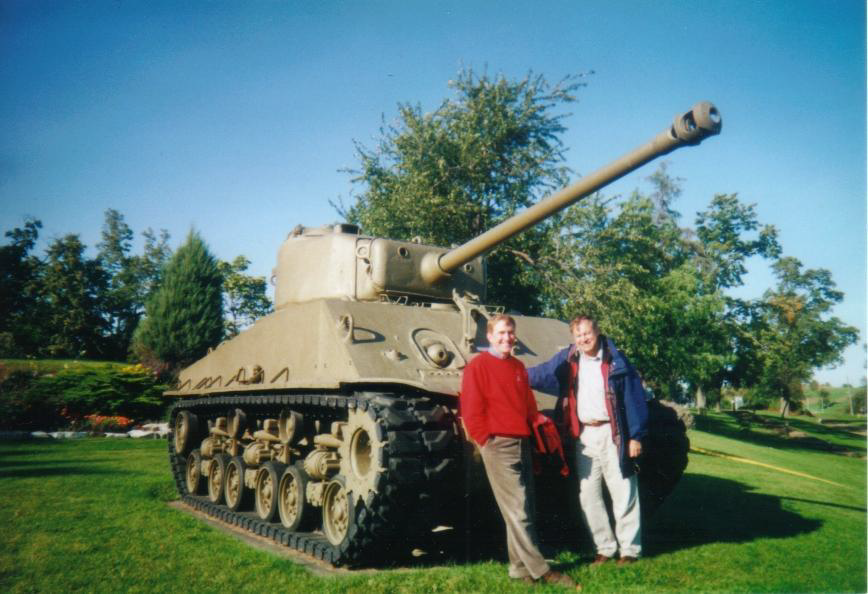
Few graduating classes can claim to have gifted something as iconic—or as heavy—as a Sherman Firefly tank to the Royal Military College of Canada. But in 1971, the Class of ’71 did exactly that, leaving behind a piece of Canadian military history that remains one of RMC’s most striking landmarks.
The tank, named Athene, is an M4A4 VC Firefly, one of the most famous Allied tanks of the Second World War. Its reputation comes from the power of its 17-pounder gun, capable of destroying the German heavy tanks that once ruled the battlefield.
A Legacy Linked to a Legend
The Firefly shares a special connection with Colonel (Ret’d) Danny McLeod, remembered by generations of cadets as “The Major.” On 15 April 1945, he commanded a Firefly during an engagement where four Canadian Shermans faced four German tanks, including a King Tiger.
“We fired everything,” McLeod later said. “And to this day I can’t tell you what happened—whether it was an HE round or the seventeen-pounder—but it bent back the tip of the King Tiger’s gun barrel about six inches.”
All four German tanks were destroyed, and McLeod received the Military Cross for his leadership. Having a Firefly at RMC preserves a tangible connection to that legacy.
From the Royal Canadian Dragoons to a New Purpose
Before arriving at RMC, Athene served with “A” Squadron of the Royal Canadian Dragoons in Petawawa. In 1957, as the regiment transitioned to Centurion tanks, the RSM refused to see this particular Firefly turned into a live-fire range target. Instead, he arranged for the tank to be transferred to the RCEME School in Kingston as a training aid for mechanics, bypassing its formal removal from service.
For more than a decade, Athene took on this unexpected second life.
A 31-Ton Problem and an Inspired Solution
In 1970, the RCEME School was ordered to relocate from Kingston to CFB Borden. Captain JS “Jack” Holt, father of Officer Cadet Peter Holt of the Class of ’71, was responsible for moving the Vehicle Training Company. One looming issue remained unsolved: what to do with a 31-ton “training aid” that was still a fully functional tank.
During an evening with classmates over Jack Holt’s home-brewed beer, the solution emerged. The Class of ’71 would take Athene and present it to RMC as their graduating gift.
The Final Drive Down the Hill
In early May 1971, Athene made her final drive under her own power from the RCEME School down to the hill beside the RMC library, where she still stands today.
Civil Engineering members of the Class—Don MacKinnon, Mike Moore, Paul Howe and others—constructed the concrete pad. RCEME cadets including Greg Barnes, Lars Eif, Jean Grefford, Bob Herbert, Peter Holt and “Mec” Morin positioned the tank in its final place.
A large group of RCAC cadets gathered to offer tactical commentary: Brian Patterson, Dave Barton, Ron Halpin, Ray Hook, Des Hunter, Paul Larose, John Moyer, Al Peterson, Roger Sashaw, Bob Shuter and Rick Williams. Whether their advice was helpful is still debated with humour.
The Legend of the 17-Pounder’s Final Aiming
The story that has lingered longest is the mysterious tale of one cadet who allegedly climbed into the turret and aimed the 17-pounder gun directly at the bedroom window of the Director of Cadets. The identity of the cadet remains unknown, and those present insist that “plausible deniability” is the only appropriate response.
A Gift That Became a Landmark
Today, Athene stands as a tribute to the initiative, humour, and spirit of the Class of 1971. It reminds every cadet who walks past that RMC’s history is shaped not only by the College but also by the creativity and legacy of its graduates.
Article contributed with historical notes from Peter Holt.